Showing posts with label drama. Show all posts

The Damned United (2009)

The Damned United follows the dramatic career of the effervescent, charming, and downright infuriating English soccer coach Brian Clough through his tenure at Derby F.C. and then powerhouse soccer club Leeds United (or the titular damned). Well, actually, the film fashions the dramatic career of Clough. The film is actually an adaptation of a dramatization, if that gives a hint. Let me first say that I’m all for artistic license. It’s up there with liquor, drivers’, and guns’ as far as licenses go. But if you’re looking for any vestige of truth within the film, stop reading. If not, let’s proceed.
It came as no surprise to me that the same director behind The King’s Speech, Tom Hooper, was responsible for The Damned United. At their core, they’re both films contingent on the powerful performances of their ensemble. And neither, in any way, disappoints. Michael Sheen of 30 Rock and Frost/Nixon fame plays Clough to complete, ideal perfection. He bounces from one scene to another with persistent charm like any ball on a pass-happy club, strategically constructing a subtly exuberant persona that demands one’s attention whether they like it or not. Timothy Spall (Peter Pettigrew from the Harry Potter series and Churchill in The King’s Speech) plays the counterpoint to Clough’s madness as his calculating but lovable assistant. The combination of the two drives the film at a quick pace as it jumps from the present, to the past, back to the present, and back again in its construction of the tempestuous history of not only Clough, but English soccer as a whole. Hooper’s expert direction and attention to character reinforces his proclivity towards personality, an illuminative precursor to the highly recommended King’s Speech. So if you enjoy soccer (or football, as the colonizers call it) or a magnificent character study, The Damned United not only satiates, but fascinates.

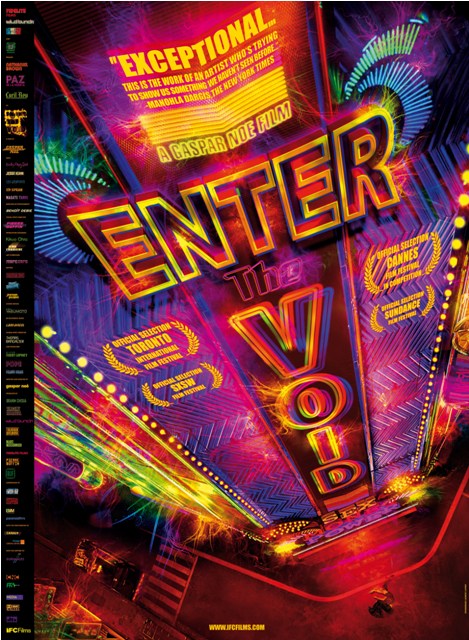
Enter The Void (2009)


This is the strangest movie I've ever seen. Even the opening credits blew me away because of how strange and how amazingly good they are. The whole movie is depicted from the point of view of the main character. By this I don't mean that the cinematography represents the main characters viewpoint I mean it's as if the camera is exactly what he is seeing and the sound, what he is hearing. This might sound like it could get boring but it doesn't, trust me. I went into this movie experience knowing absolutely nothing about the film except that I had heard it was weird. I think that was a good way to see it so I don't want to elaborate a whole lot on the film because not being informed definitely impacted my viewing of it in a good way. That being said I'm going to apologize for any vagueness.

The main character is an unorthodox protagonist for a film. He's not really a hero but neither is he an anti-hero, if you met him in real life you might not want to be his friend but I don't think you'd find him particularly appalling either. If this film had been done much differently it would have been as boring as that sounds, but it's not. At times I wanted to stop the film and put on Jersey Shore just so I had something else to watch, but I couldn't. It pulls you in and leaves you in a stupor for the rest of the day. The script is sparse and light but the story is heavy and dark. The characters intertwine in ways neither you nor they are aware of or expect. A large amount of the film is psychedelic video art that reminds me of an exhibit I saw by Nam June Paik last year which made me rethink the boundaries of art. At times the movie does such a good job of this that it almost feels as if you are on copious amounts of hallucinogenic drugs wandering through Tokyo (something I've never done but I can only imagine it's something like this film). The rest of Enter The Void tells the life story of one person, from their point of view, in a completely non-linear fashion. I'm going to repeat myself, there is no succinct timeline for the film... at all, and the psychedelic scenes are mixed in with these already mixed up bits of life.

There are numerous reasons for why I shouldn't have liked this film but I did. The images and sounds are incredible, graphic, and vibrant; the story is unique, heartfelt, and disturbing as are the characters. The whole thing is incredibly sexual, violent, and surreal all at the same time. It leaves you wanting more and needing to shut down your brain at the same time. To conclude, you should see this, but do so knowing that it is going to take something out of you, you will be disturbed, and I can only hope you like it as much as I did, though I understand any body disliking it. It's not a movie that can described in any accuracy but must be seen to be understood.

WARNING: This movie contains a great deal of bright flashing lights and other visual effects that may induce an epileptic seizure.

Dog Day Afternoon (1975)

Dog Day Afternoon is, start to finish, non-stop twists, turns, accidents, betrayals, misunderstandings, surprises, and panic. Unlike most films depicting any sort of heist, the movie begins right as Sonny (Al Pacino) and his accomplices walk into the bank they plan to rob, guns under their arms in large white packages. As soon as Sonny viciously rips open his box while standing in the teller line this raucous and turbulent drama takes off like a rocket. Right away things go terribly wrong: one of Sonny's two accomplices gets cold feet and runs off, and that's before they've even discovered that there's practically no money in the bank's vault. Then while Sonny tries to plot his next move, he's discovered by Brooklyn police, automatically making our hero the proprietor of a full-blown hostage situation, complete with helicopters, snipers, press, and crowds of people, most of whom eventually take Sonny's side in the conflict.

From the minute this film started I couldn't take my eyes off the screen. It'll have you on the edge of your seat, grinding your teeth with nervous anticipation for whatever is going to go wrong next (because very quickly you'll discover a pattern of things going wrong). The characters are rich and complex, in particular Sonny, who you never stop learning interesting things about. Speaking of which, I'd just like to say, the Netflix description makes a big deal about the fact that Sonny is robbing the bank to pay for his gay lover's sex change operation. Now, it's certainly an interesting element of the story, but the fact is you don't even learn about Sonny's lover until about an hour in to the film. This film is about a bank robbery, executed by desperate, disturbed Vietnam vets, that goes tragically wrong. A guaranteed thrilling and riveting crime drama that packs more excitement into two hours than you ever thought possible.

Oh ya. And it's a true story.

Barton Fink (1991)


Sitting here, I can’t help but feel like the titular playwright behind the Coen brothers’ 1991 drama/comedy/horror/film noir masterpiece Barton Fink. I don’t know where to begin this post, and I certainly don’t know where, or how, to end. The film confounds. You see, Barton Fink is a film about process: torturous, consuming, emasculating, arduous process. John Turturro stars as Fink, a celebrated playwright in New York who travels west in the hopes of securing enough capital by writing a “wrestling picture” for Hollywood to continue his dramatic bent towards the “struggles of the common man.” Fink arrives in L.A. and checks in to the decrepit Hotel Earle, wherein he discovers his (philosophically) platonic literary subject in the form of an insurance salesman, Charlie Meadows (John Goodman). This is only the beginning of Fink’s prolonged odyssey through Hollywood. As the playwright turned screenwriter struggles with his own creative vision, he must pass through the crucible of L.A.’s most erratic gatekeepers in the form of producers (the Oscar nominated performance of Jack Lerner) and writers, one of which bears an uncanny resemblance to William Faulkner. The process of “plunging the depths” drives Fink toward absurd and apocalyptic consequences in an unforgettably horrifying ending.
Barton Fink is the Coen brothers’ most allusive and literary film to date. The composition of Hotel Earle eerily resembles that of the Overlook (The Shining), and the continued references to fascism, religion, and the writing process as a whole render the film tantalizingly cryptic. Fink challenges notions of maintaining an objective reality in the face of a singularly subjective pursuit, characterizing the unsettling truth that the existence of a middle ground is not only absent, but disturbingly so. The Coen brothers’ have a knack for journeys, and the interiority and intimacy of Fink proves their own genius at such an early stage of their own.

The Wind that Shakes the Barley (2006)

The Wind that Shakes the Barley relates the fascinating and tempestuous history of Ireland’s social and political revolution beginning in 1919 and concluding with a two year Civil War from 1921-1923, ending in the independence of the southernmost 26 counties. Cillian Murphy stars as Damien O’Donovan, a native Corkonian just at the cusp of entering the medical profession in a London clinic as Ireland spirals deeper into political upheaval and uprising. Despite the brutality of Black and Tan militias marauding throughout the Southwestern countryside, Damien nevertheless sets his sights on a career removed from the enveloping violence. Just as he is about to leave for London, he witnesses the beating of the train conductor (and member of the Irish Citizen’s Army) at the behest of a crazed British soldier, and thus returns to fight in the Irish Republican Army. Through his eyes the audience becomes privy to the clandestine actions of the countryside’s rebels as they mobilize against the British, and according to fated history, fall into a taxing and violent Civil War.
Once you get used to the near codified Cork accent (luckily I grew up knowing that “tree” was numerical, not arboreal, from my grandpa) the dialogue and pace of the film blazes through two captivating hours. Many, however, have called the film slow, and I should quickly point out that the plot holds special academic as well as familial significance to me, so I found the entire 120 minutes enthralling. The film is not entirely historically accurate, but luckily, it makes no claim to be. Instead, it uses the Cork countryside as a focalization of the many issues that pervaded the Irish independence movement: property, politics, economics, and class. To properly understand every aspect of the film, one would indeed have to hail from Ireland, but I fear even that would not be enough. This should not dissuade one from watching the film; instead, I hope it proves the opposite. The British are portrayed as brutish, while the Irish cause is unabashedly romanticized contrary to its stark realities. Nevertheless, they are realities that provide substantial cinematic fodder and The Wind that Shakes the Barley utilizes them to the utmost. Highly recommended.

Mean Streets (1973)


Widely considered to be Martin Scorsese’s first feature length (Who’s that Knocking at my Door? and Boxcar Bertha were student projects at NYU), Mean Streets is the celebrated director’s most personal, and I would argue, most cryptic film in his vast anthology. The narrative follows small time mobster Charlie (Harvey Keitel) as he attempts to cope with his own Catholic guilt through fraternal care for the irascible, erratic, but nevertheless amiable Johnny Boy (Robert DeNiro, in what would prove to be his first of many collaborations with Scorsese). The film takes place all across Scorsese’s hometown of Little Italy in New York, bouncing between bars, street festivals, and movie theaters as Charlie, Johnny Boy, and the rest of their gang partake in frivolous exploits, validating their masculinity like so many bullies across an urban playground. Unlike Goodfellas or Gangs of New York, Scorsese’s gangsters in Mean Streets lack any sense of gravitas, promising to score a couple kids some fireworks and instead piling into a Cadillac and using their money to see The Searchers. All the while, Charlie dates Johnny Boy’s epileptic cousin, ostracized for her condition. What appears petty throughout proves to possess catastrophic consequences, as Johnny Boy’s nonchalance tries the patience of Charlie and, more importantly, those less forgiving.

Look familiar?
While Taxi Driver relied largely on the collaboration of writer Paul Schrader, the acting of DeNiro, and precision directing, Mean Streets is wholly Scorsese. The man understands Little Italy for its nuances and subtleties, but more importantly, conveys them onscreen in a deeply personal fashion lacking in his more recent projects. The trademark Scorsese tropes of Catholicism, masculinity, race, class, redemption, and guilt pervade the entirety of the film from its opening shots, serving as the most incendiary introduction possible for one of, if not the, greatest of American directors. Additionally, Scorsese scores the film perfectly, and it’s been said that securing the rights to all the pop and rock songs cost half the film’s budget. The film is awash in the neon reds and blues that would fill the canvas in many of his later projects. The use of a handheld camera, rising just as much out of economic necessity as a desire for intimacy, grants the film its deeply personal aura. Keitel and DeNiro perform, predictably, incredibly. I can’t recommend this film enough; with such easy access on the Queue and repeated viewings, it could become my new Scorsese favorite. 


North Face (2008)


Given that we've reviewed a movie about Nazis in the snow and a movie about mountain climbing, I figured it only right to review a movie about Nazis in the snow climbing a mountain.

The 2008 German film North Face recounts the 1936 attempt to summit the Eiger via its north face, one of the deadliest routes in the world having accounted for 64 deaths since 1935. The narrative arc follows a pair of German climbers disillusioned with the political climate surrounding Nazism and more intent on honing their mountaineering skills as they compete against a pair of Austrians with similar aspirations for conquering the indomitable Swiss peak. All the while, a reporter from Berlin (Ulrich Tukur, notable for his role as Grubitz in the highly recommended The Lives of Others) propagandizes their climb as exemplary of German athletic prowess. A young photographer accompanies the reporter, and acts as a love interest throughout the film for one of the climbers. Once the climbers’ ascent begins they face a series of challenges and setbacks, dooming them to face the harsh weather and unforgiving landscape of the Eiger.

Nazi Bromance.
For a film about a mountain, North Face is unfortunately flat. Nearly every element feels contrived, injected into the plot line as an arbitrary means of heightening the drama and inevitably distracting from the excitement of the historical reality. The direction was thrilling and visceral, enveloping the viewer in the Eiger’s erratic weather and terrifying beauty, while the script faltered along, barely able to conjure any empathy for the characters. The romance between climber Toni and photographer Luise remained unsubstantiated and thoroughly uninteresting from beginning to end. The soundtrack kept making me think I was watching a Michael Bay film. Tukur stands out as the only memorable performance. I would recommend North Face purely for the sake of its adventure, though it never quite achieves what appeared to be a potential for greatness.

A Prophet (Un prophete) - 2009


A French film, A Prophet follows Malik, an Frenchman of Arabic decent. At 19, Malik is sentenced to six years in a prison divided between Arabs and Corsicans. Through a twist of fate, Malik becomes involved with the powerful Corsicans, and through the film rises through their ranks, before eventually taking control of his own fate.


A Prophet is a gritty prison film, but at it's heart it is also a coming of age movie. Malik enters the prison and the film as a nervous, naive boy; as the years pass prison transforms him into a hardened criminal and survivor, loyal only to himself. It is his personal development, rather than his upward advancement through the French underworld, that is the driving force of the movie. Tahar Rahim is convincing as Malik, but Niels Arestrup is outstanding as the frightening, then deteriorating Corsican leader Cesar Luciani. Shaky-cam, so often obnoxious, is used subtlety enough to create a personal, visceral feeling. A Prophet is a long movie, and at times loses momentum in the middle, but it picks up speed again towards the end. The movie, alongside Malik, creeps up on you slowly. It's well worth the watch.

Eyes Wide Shut (1999)

On the surface, this movie seems like a typical Kubrick flick complete with single camera shots, trailing from room to room of meticulously laid out sets that feature mediocre acting performances by at-the-time power couple Tom Cruise and Nicole Kidman. However, beneath the shallow characters of Bill and Alice Harford lies a more complex story told through, however slow moving, action. Bill and Alice have been married for nine years and have a daughter, the opening Christmas party scene sets up the thoughts they are both having of sexual promiscuity. After Alice confesses to fantasizing about a certain naval officer, Bill sets out on a quest to the underground sexual depravity scene of New York City. He intermingles with characters from kind prostitutes to overly wealthy members of a secret cult who partake in ritualistic orgies. He is able to infiltrate the disturbing group with the thinly veiled metaphor of a Venetian mask.

Although the film can get a little preachy, pounding in messages of the morality of differing socioeconomic classes and the perils of betraying monogamous relationships, its ultimately a film worth your time, if only for the sake of its imagery and creative story telling.