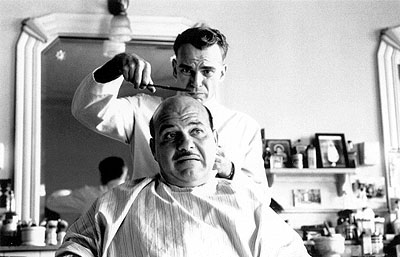
Directed by the Coen brothers,
The Man Who Wasn't There is a neo-noir, by date only but is so close to the stylization of the original genre its almost ridiculous not to call it a film noir. Labels aside this movie is incredible on so many levels. First of all, Billy Bob Thornton does a fantastic job in this as do supporting actors James Gandolfini, Michael Badalucco and actresses Francis McDormand and a very young Scarlett Johansson. One of her first roles, Johnansson is already a great actress in this film and its great to see an early role of someone who is likely to have a long successful run in Hollywood for the next 30 years. The script is dry and coarse but fits the film style well and matches the general outlook of the protagonist, his narration has some effect on this but the dialogue throughout matches his view of the world as well. Not to mention this film has one of my favorite car crash scenes of all time.

The plot revolves around a barber, Ed Crane (Billy Bob) in a small town where Big Dave Brewster also runs a large clothing store, a precurser to mall stores like J.C. Penny and the like. Doris Crane (Francis McDormand) is Ed's wife and works for Big Dave. Like most noirs there is a murder as well as a number of tangent and seemingly unrelated plot lines all of which converge throughout the film, I'm not going into them here because it would be difficult to not give some things away while discussing them so you'll just have to take my word and respect for the Coen brothers' writing ability that the plot is good. But that is rather beside the point, while the plot is strong and drives the action well, what sets this film apart is the cinematography.

The framing alone in this movie blew my mind the first time I saw it. They are able to make basic scene-scapes seem slightly distorted and of kilter, much like the protagonist's slightly twisted view of reality. The Coen brothers use light and dark to magnificent effect creating surreal environments in everyday locations, breaking some rules of the noir genre with an overabundance of light in many scenes but do so consciously, with purpose, and to great effect. The scenes in which the classic noir feel comes through and darkness overpowers the screen with objects coming out into the light (the opposite of most film categories) are also done very well and develop a cold dark world that everyone lives in without realizing the dismal reality of their existence. The editing in this film is also spot on and does a great job of developing a slow, patient rhythm rarely seen in Hollywood films of today. To be perfectly honest this movie made me cry and it did so through the pure beauty and artistic merit of the filmmaking. One of the Coen brothers' least known and best works,
The Man Who Wasn't There is worth watching, over and over again.
 A modern screwball comedy about the ever turning wheels of fate. After an absurd scene in which Waring Hudsucker, president of Hudsucker Industries, leaps out a window to his death during a business meeting, small-town optimist Norville Barnes (Tim Robbins) finds himself a puppet in Sydney Mussburger's (Paul Newman) evil scheme to take control of the company. Sydney promotes Norville from mail room clerk to president after Norville shows him the drawing above, explaining that it is a design that is "You know, for the kids" and that he's been working on it for years. Sydney assumes Norville is an idiot and therefore a perfect proxy during the transition after Waring's passing. What Sydney doesn't realize is that Norville has designed the hula-hoop, a toy that turns out to be one of Hudsucker Industries' biggest successes.
 Screwball comedy isn't a genre term that gets thrown around a lot, and that's because it's a genre that more or less died out in the 1940s (with a handful of exceptions). Hudsucker is set in the same time period, and so the film can feel almost a little like parody rather than a new neo-genre, especially during the news paper room scenes, reminiscent of classics like His Girl Friday (1940), complete with a fast talking Hepburn-esque leading lady struggling to be one of the guys. Highly recommended if you enjoyed other cryptic Coen classics like Barton Fink or are a fan of the classic genre. Hilarious cast, guaranteed laughs throughout.